Tuesday, 14 July 2015

Tools and Trades Tuesday #3


 Pictured Above:
Late 19th Century Automatic Corn Planter or “Corn Jobber”
Donated by G.A. Ross of Vankleek Hill
1962-069-026  
Welcome to the third edition of Tools and Trades Tuesday. Today we will be discussing the glamorous life of a farm hand and the tool that changed their life, the corn planter, also known as a “corn jobber”. Unlike many other grains of the period, corn needed to be planted one seed at a time. As you can imagine this would be a very strenuous task and would require days if not weeks to plant entire fields, and through the need to complete planting much quicker corn jobbers were invented. The first of these devices were very simplistic and the process of planting the seed was actually performed by the operator himself, but eventually progress was made and soon an automatic planter was in use, like the one pictured above. This is how the mechanism worked:
  1. The operator would hold the handle in one hand while their foot was firmly placed on the foot    hold at the bottom.
  2. The end with two blades was placed in the ground as the farmhand walked
  3. Once in the ground the device was tilted forward slightly and a piece of corn would fall down into the hole created.
  4. It was then lifted from the earth and the process could begin again.
This way of planting crops completely changed how much farmers would plant, as you could finish a field as fast as a man could walk it. This could be considered the beginning of the cash crop era. Some old texts from the period give a description of the process and dictate that the work and time of planting a field was cut down by as much as ¾. At the museum we have 3 different corn jobbers that show the progression of the complexity of this device, from the first ones that were hand operated to the final design being automatic.

Thursday, 9 July 2015

Tweedsmuir Thursday #3


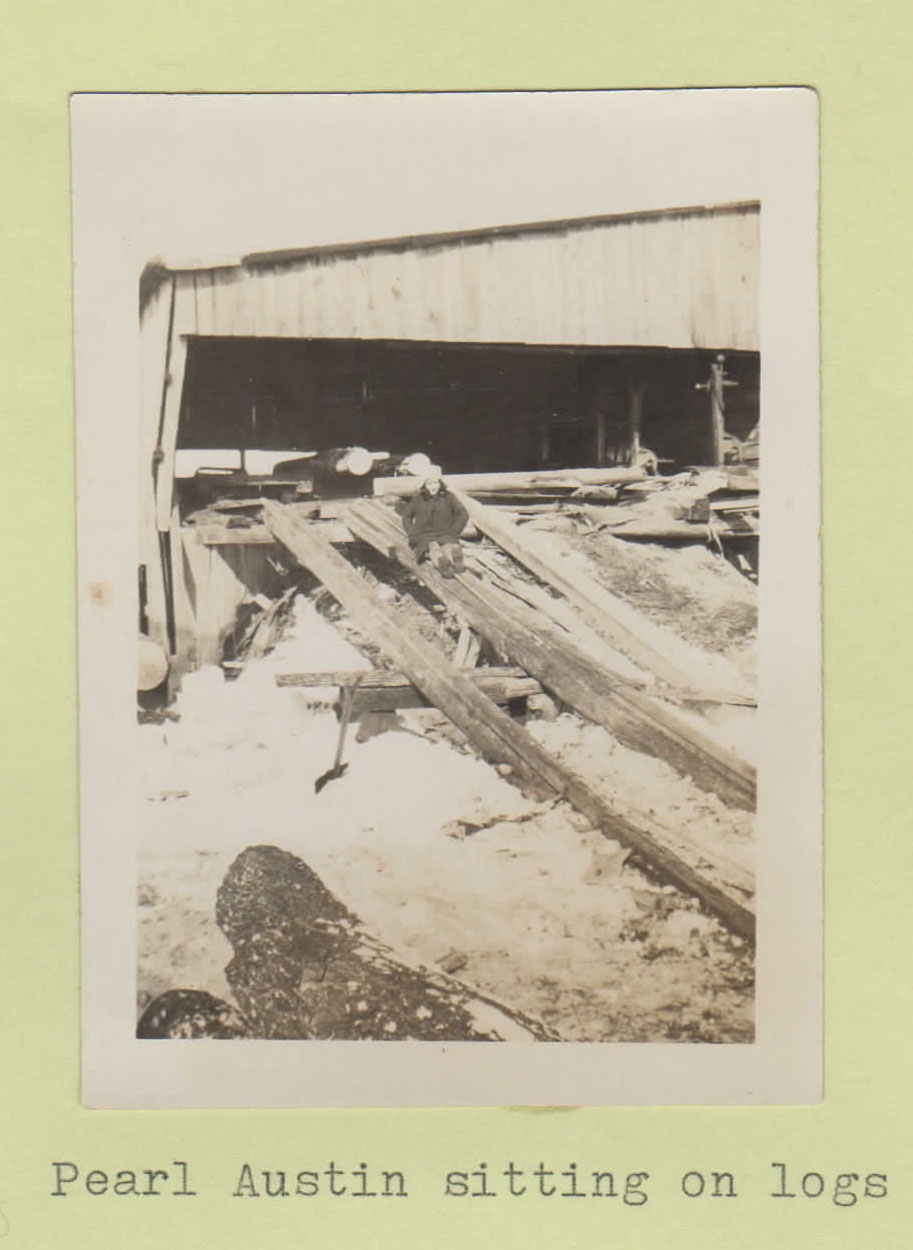
In the last quarter of the nineteenth century, Dunvegan was a bustling town with many lucrative businesses, tradesmen, and merchants. The construction of the C.N railroad in 1880-1884 triggered the growth of many businesses including, a gristmill, a couple tanneries and asheries, a tinsmith, a blacksmith, a shoemaker, general stores, hotels, and sawmills.

The above photographs were taken of the Dunvegan sawmill. Originally owned by Dan MacKercher of Moose Creek, it was sold in 1919 to W.A MacEwen of Maxville. Unfortunately, the Tweedsmuirs do not list the year the sawmill was established. Shortly after the sale, the mill was dismantled and resold again to Mr. W. W. (Wallie) MacKinnon and transported by horses to Dunvegan, where it was reassembled on the south side of the road beside the creek in the village. The mill was in operation again by the early 1920’s. Powered by steam, the creek supplied the water for the boiler and slabs and sawdust from the mill provided the heat source.

In the winter months, logs were brought to the lumber yard by horse and sleigh. In the early spring, sawing began with employment of approximately ten local men and a full-time fireman. The mill’s lumber was sold all over the county and throughout Ontario. Electricity had not yet arrived to rural areas and residents depended on slabs of wood that the mill delivered by horse and dump cart, to keep their stoves burning for warmth. A lot of lumber was also hauled to Greenfield and loaded on flat cars at the train station. Frank Philips was a teamster for many years and took pride in the large loads his team “Paddy and Jack” could haul. Mr. MacKinnon always kept two teams of horses.

Several times a year, there would be special orders for ash wood to be used for sporting equipment. Farmers in the St. Elmo area, who shipped milk to Montreal, came to the mill yard for sawdust to pack their ice for the summer months. Companies from Montreal and Casselman also purchased lumber from the mill. The mill also made shingles from cedar blocks and cheese boxes, which were sold to Neil Fraser of Vankleek Hill who sold cheese from his factories in wooden boxes.  

The men who worked at the mill had dinner at the MacKinnon home in town and some even stayed in the home during the workweek. It was apparently a busy household with five young children running around.

In 1942, the mill was sold to D.A Graybut. A few years later, it was resold and moved to Quebec. Although nothing remains of the sawmill on the site today, the milled lumber could possibly be found in old houses throughout the Glengarry countryside.


Tuesday, 7 July 2015

Tools and Trades Tuesday #2


In our second edition of Tools and Trade Tuesday we will be exploring the crucial job of logging and one of the tools of that trade. In the long winter months, farmers were unable to till the lands and produce crops, which were required in order to not only feed their family but also provide income. To compensate, logging became a common winter profession as Canada in the early 19th century was abundant with trees. When this trade first began to blossom, there were not many rules or regulations to protect the exporter’s product and often times their timber would be stolen.  In the late 1800’s, a method of marking the timber before shipping it down the river to Montreal or Quebec City became common practice.

Now this brings us to our featured artifact, a logging stamp. These stamps were often cast from iron, which made a very sturdy and strong tool. The front face with the logo was placed against a log then was struck from the back end with another hammer, creating an imprint within the log to identify the owner and ensure proper compensation. Although many people were using this method of marking their timber, product was still being stolen and the government developed a solution. They imposed hefty fines for anyone who did not mark their logs and even larger fines if someone was caught marking someone else’s. Every year the logging company would have to re-register their logging stamp design with the government which lead to a great variety of logging stamps. Here at the museum, we currently have two on display, but that is only a fraction of the total number in the collection. In 1994 Mr. Robert Kirkpatrick of Lochiel, donated 37 different logging stamps registered to companies throughout Quebec and the Ottawa valley. The logging stamp is a fascinating tool of the lumber trade and reminder of days gone by when trees played a huge role in the lives of pioneers.

Thursday, 2 July 2015

Tweedsmuir Thursday #2


This building might look familiar to many Dunvegan residents: the DRA (Dunvegan Recreational Association) Hall. The DRA Hall, like many historic buildings, has served many purposes and organizations in its lifetime.

Built in 1919, the building was constructed to replace the original Loyal Orange Lodge, erected in 1867 and used as a meeting place for Orangemen in Dunvegan. After the new Orange Lodge was built, the original was sold to Alex Urquhart who moved it across the road and used it as a private house. In 2005, it was dismantled and moved to the museum. Although talk of a new Orange Lodge began in 1914, the First World War stopped plans and no mention was made in minutes until Feb. 1919.

The new Lodge was built by Frank Schell of Maxville and constructed of cement blocks and originally two storeys high. Members of the Building Committee received $1.00 per day for their labour. Since its opening, the hall was used not only by the Orange Order but also other organizations in the community. It was used for church suppers and events, dances, etc. During WWII, it held parties for every boy that joined the Armed Services.

As time passed and talk of disbandment brewed among the few Orange Order members, they turned the hall over to the Women’s Institute for a fee of $600 in 1974. The Orange Order and W.I had a close relationship and a history of organizing events together including, an annual Turkey Supper to raise funds for both organizations.


In 1978, the hall underwent extensive renovations. The cement blocks at the top of the building were cracking and the walls were spreading apart. Members feared the hall was unsafe and Angus John MacLeod undertook the task of renovating the hall into a one-storey building and constructing a new roof.  The above photographs are some before and after shots of the building. Below is a photograph of an Orange Order meeting at the Hall in 1921. These are from two pages in the Dunvegan Tweedmuirs.


Tuesday, 30 June 2015

Tools and Trades Tuesday #1


Above: A bloodletting knife that would have been used by a Barber Surgeon to treat patients.

Blacksmith, Tinsmith, Carpenter, Lumberman, Shoemaker, Doctor, or weaver – The list goes on. For every pioneer trade, there are a multitude of tools that go with it. Every Tuesday, we will feature a tool from the collection. Some, like this bloodletting knife, may seem outlandish today, but was considered essential for a doctor or “Barber Surgeon” in the 19th century.

The process of bloodletting was the release of large amounts of blood from either veins or major arteries and it was believed to cure many ailments. This process of removing blood from the body to purge toxins from the system can also be traced back as far as 1000 B.C.E. when people were looking for explanations for many bodily illnesses of the time. Although today this is viewed as absurd, it was regarded as a common treatment for almost 2000 years.

During the 19th century, bloodletting had become such a widely used operation that barbers, which were the surgeons of the time, began to advertise their ability to perform such tasks. A person would have the local doctor attend their home and often times he would recommend a session of bloodletting, at which the patient would travel to the local barber surgeon to have the procedure done. This medical treatment was used right up until the late 1930s, but quickly people were discover that it was often making people more ill or even in some extremes death.

Thursday, 25 June 2015

Tweedsmuir Thursday #1

Above: Photo of Lady Tweedsmuir from the first page of the Dunvegan Tweedsmuir History Book


Welcome back to the weekly blog! This year we are introducing Tweedsmuir Thursdays, one of two weekly blogs. Tweedsmuir Thursday will feature fascinating stories, photographs, clippings, etc. from the museum’s Dunvegan Tweedsmuir collection. What is a Tweedsmuir? Tweedsmuirs are local histories that were compiled by Women’s Institute branches beginning in the 1940’s. They were named after the Governor General of Canada from 1935-1940 and his wife, Lord and Lady Tweedsmuir. Lady Tweedsmuir was a member of the Women’s Institute in England and while visiting Ontario, she took great interest in the Women’s Institutes and was made an Honorary Life Member of the Federated Women’s Institute of Ontario. She became very passionate about preserving the history of the Canadian people and advocated for the WI branches to compile village history books in order to preserve the history of each community.


Tweedsmuirs resemble scrapbooks because they contain historical information in various formats like newspaper clippings, photographs, handwritten histories, etc. Every Tweedsmuir is different and styled in a unique way. Despite this, they all contain various historical information on the community including; churches, schools, land and property, events, war effort, biographies, and earliest settlers, etc. In January 1942, a motion was made and seconded by the Dunvegan Women’s Institute that the history of Dunvegan be written.


What is the Women’s Institute? The WI was founded in 1897 by Adelaide Hunter of Hamilton, Ontario. After the death of her first child from drinking unpasteurized milk, she dedicated her life towards the education of women. Adelaide gained a large following which led to the development of the first branch of the Women’s Institute.
 

The Dunvegan Women’s Institute began on April 2, 1935 with a meeting of twenty ladies. Mrs. Mary Chisholm and Mrs. Mary MacIntosh thought it would be enjoyable to have an organization that every woman, regardless of race or faith, could attend.


In May 2001, the Dunvegan Women’s Institute disbanded. Their contribution to the community and dedication to the preservation of our local history will not be forgotten.


Stay tuned for exciting stories from the Tweedsmuirs that will be shared with you this summer.

Thursday, 14 August 2014

Farming Fridays


This is an egg incubator which was used for hatching chicken eggs. Mechanical incubating was not invented until the year of 1749 by Reamur in Paris, France. Prior to this invention, one of the first recorded methods of incubating included using the heat of rotted manure to warm the eggs.


Although this incubator is mechanical, it was still before the availability of electricity to farms, instead, a coal oil lamp was used to heat water, circulating by convection through pipes around the perimeter of the incubator. This incubator is a cabinet style, made of redwood and could be suitable for indoor decor. Very few of these can be found today, making this item rare, especially because the incubator still has the original kerosene attachment. The cabinet style has drawer pull-outs for placing the eggs and for turning. Most incubators required hand turning of the eggs.

Saturday, 9 August 2014

Farming Fridays


This McCormick Deering cream separator is used to separate fresh milk into cream and skim milk. Often the skim milk was consumed by the farmer and his family and the cream was saved to make butter, or it would be sold.
Before the centrifugal mechanism such as this one, milk was separated by letting it sit in a container until the cream floated to the top and could be skimmed off by hand. But the centrifugal separator makes it possible to separate cream from milk faster and more easily, without having to let the milk sit for a long time and risk it turning sour.
This one was originally a hand cranked machine but a motor was later added around 1925. The fresh milk gets poured into the supply can at the top, and then leaves the bowl through a valve on the side and passes into the disks where the cream separates. Good separators have a bell in the center of the gear (ours is missing); this allows the user to tell when the cream separator was being cranked at the right speed, usually 60 revolutions per minute. If the bell was ringing the cream separator needed to be cranked faster. This speed was very important for the cream separator to operate at peak efficiency. There are two different spouts at different heights, the top spout pours out the cream and the lower spout pours out the skim milk. Floor model cream separators such as this one often have a swinging platform where a bucket would go to collect the cream. 

Friday, 8 August 2014

Glengarrians & The Great War


This unique wheelchair belonged to Pte. John Alexander Grant. Grant was born in Apple Hill on September 5, 1896 to Mr. & Mrs. Duncan A Grant. He enlisted in the Canadian army on March 11, 1916 in Maxville, ON.  He was stationed during the First World War in England and France. During his time in France, he suffered a severe  injury, which resulted in shrapnel wounds and the amputation of both his legs. He was given this wheelchair, equipped with operating handles, once he was discharged from the army. It is believed that he continued to have a military presence by becoming a recruitment officer for local military branches.


        His wheelchair was donated to the Glengarry Pioneer Museum by the Estate of Myles Edwards c/o Bill Edwards. Myles refurbished the wheelchair and obtained a copy of Pte Grant's service and medical records but the connection between the Edwards and Grant families is unknown because of the death of Myles Edwards.